Why the Question “Is Pigment Ink Safe?” Matters in 2025
As global regulations tighten and consumers demand safer, more eco-friendly textile products, one question consistently emerges in the international textile supply chain:
“Is pigment ink safe for clothing, skin contact, and export-grade textile manufacturing?”
According to major industry reports (AATCC, OEKO-TEX, ZDHC), pigment ink has become one of the world’s most trusted and eco-friendly textile printing methods. In North America, Europe, Japan, Korea, and Australia, pigment printing has surged 20–45% in adoption because brands require:
-
Skin-safe materials.
-
Chemical compliance.
-
Low environmental impact.
-
Fast production cycles.
This shift has also accelerated the adoption of direct-to-fabric pigment printing (DTF-Pigment) in Vietnam—especially for export manufacturers and private-label brands.
This article provides a full technical, factual, and B2B-oriented analysis of pigment ink safety and explains why many international buyers now choose pigment-printed fabric from Vietnam.
2. What Is Pigment Ink? (Technical Yet Reader-Friendly Explanation)
Pigment ink is a water-based ink formulated with color particles (pigments) dispersed in a liquid carrier. Unlike dye ink, which penetrates the fiber structure, pigment ink stays on the surface and is bonded using heat or fixation technology.
Key characteristics:
-
Water-based, non-toxic formulation
-
Contains micro-pigments under 0.2 microns
-
Requires no steaming or washing
-
Low energy and water consumption
-
High durability for garments and home textiles
This streamlined process makes pigment printing one of the cleanest and safest textile printing technologies currently available.
3. Is Pigment Ink Safe? (Evidence-Based Answer)
Yes, pigment ink is completely safe — when produced according to international standards such as OEKO-TEX, CPSIA, and REACH.
Why? Because pigment inks :
3.1. Are non-toxic and water-based
Pigment ink does not use harmful solvent components. This makes it safer for workers, consumers, and the environment.
3.2. Contain no heavy metals
Certified pigment inks are free from:
-
Lead (Pb).
-
Cadmium (Cd).
-
Mercury (Hg).
-
Nickel (Ni).
-
Chromium (Cr6+).
3.3. Contain no formaldehyde
A major requirement for:
-
EU REACH.
-
US CPSIA.
-
Japanese textile skin-contact standards.
Formaldehyde-free printing ensures skin comfort and prevents allergic reactions.
3.4. Do not release harmful VOCs
Volatile organic compounds (VOCs) are minimized due to water-based formulation.
3.5. Are safe for direct skin contact
This is particularly essential for:
-
Infant clothing
-
Underwear
-
Sleepwear
-
Socks
-
Home textiles
3.6. Meet OEKO-TEX Standard 100 requirements
Top pigment ink brands earn OEKO-TEX certifications, ensuring safety for sensitive skin.
3.7. Offer strong wash durability
Durability reduces dye migration and residue issues.
In summary:
Pigment ink is one of the safest and most environmentally responsible textile inks available.
4. Why Global Brands Prefer Pigment Ink
Pigment ink has gained popularity among major fashion brands, sportswear companies, home décor retailers, and private-label manufacturers. The reasons are straightforward and measurable:
4.1. Skin-safe and compliant with global chemical regulations
Brands must follow laws like:
-
REACH (EU)
-
CPSIA (USA)
-
OEKO-TEX 100
Pigment ink makes compliance simpler.
4.2. Sustainable and water-saving
Pigment printing eliminates:
-
Pre-treatment washing
-
Post-treatment washing
-
Steaming steps
This reduces water usage by 70–90%, making it ideal for brands with sustainability goals.
4.3. Faster production cycles
Fewer steps → faster time-to-market.
Suitable for fast fashion, capsule collections, small batch testing, and custom designs.
4.4. Exceptional detail and print quality
Modern pigment printers deliver high-resolution output (600–2400 dpi).
4.5. Strong fabric versatility
Works on:
-
Cotton
-
Linen
-
Canvas
-
TC, CVC
-
Polyester blends
-
Home décor fabrics
5. Direct-to-Fabric Pigment Printing: The Most Advanced Form of Pigment Technology
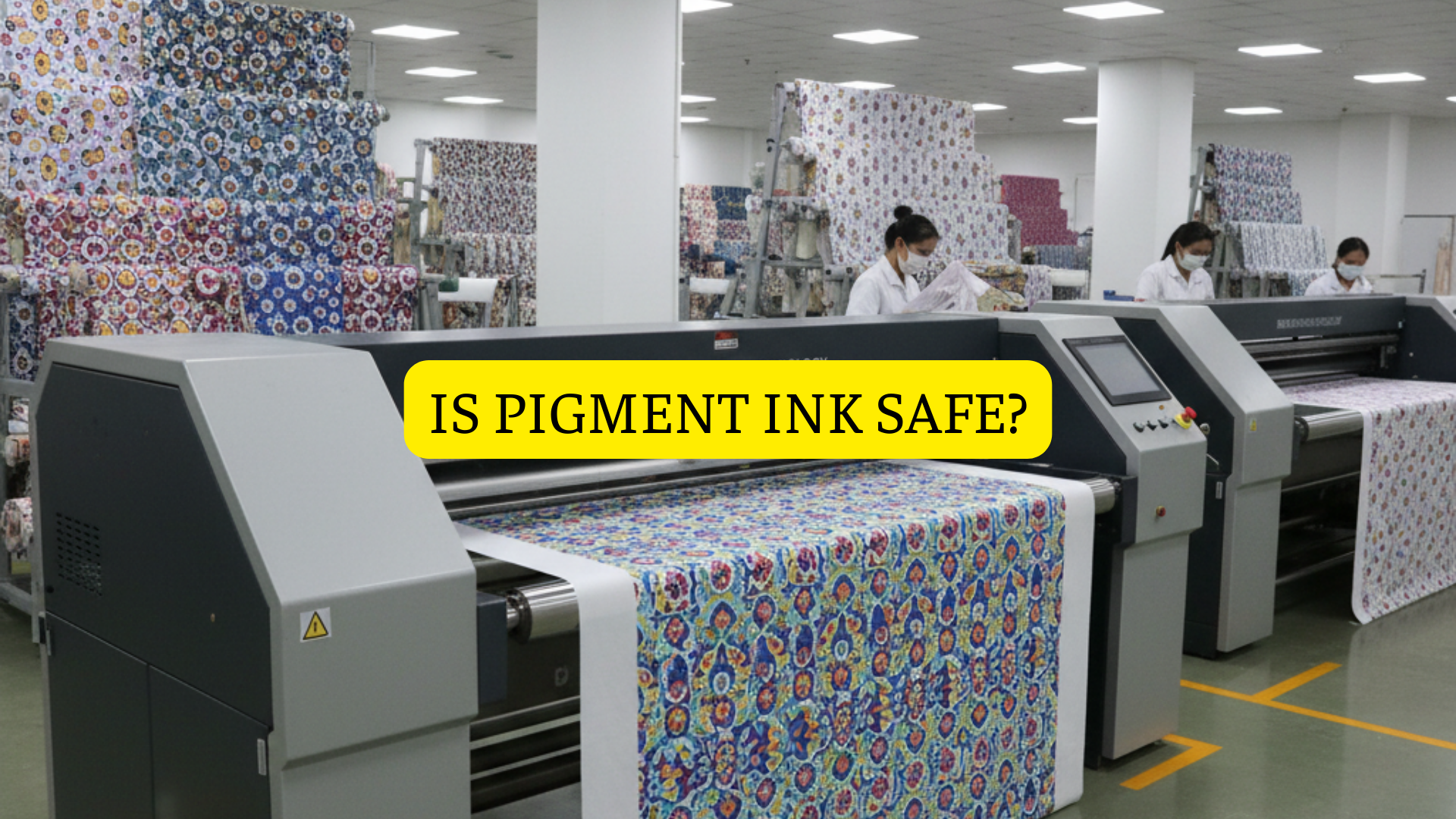
Direct-to-fabric (DTF) pigment printing is the cutting-edge evolution of pigment ink technology. Unlike screen printing or heat transfer, DTF-Pigment applies ink directly onto fabric using precision industrial heads.
Key advantages:
✔ Superior image clarity
Fine details, gradients, micro-patterns.
✔ Soft hand-feel
Advanced binders create a soft, flexible print surface.
✔ High wash durability
30–50 washes depending on fabric type.
✔ No pretreatment for many fabric categories
Reducing time, cost, and environmental impact.
✔ Consistent color for bulk orders
Crucial for export consignments.
6. Is Pigment Ink Safe for Children’s Clothing?
Yes — pigment ink is widely used for children’s apparel in the EU, USA, and Japan.
Industry requirements for children’s products include:
-
Zero formaldehyde
-
Zero heavy metals
-
Zero allergenic dyes
Pigment ink naturally meets these requirements when certified.
Common applications:
-
Baby bodysuits
-
Pajamas
-
Kids’ dresses
-
Cotton T-shirts
-
Bed sheets and pillowcases
-
Baby blankets
Global babywear brands often specify pigment printing due to its chemical safety profile.
7. Safety Comparison: Pigment Ink vs Other Ink Types
| Ink Type | Safety Level | Environmental Impact | Durability | Production Notes |
|---|---|---|---|---|
| Pigment Ink | ⭐⭐⭐⭐⭐ (Excellent) | 70–90% water savings | High | No steaming, no washing |
| Reactive Dye | ⭐⭐⭐⭐ | Medium (high water usage) | Very High | Requires washing + steaming |
| Acid Dye | ⭐⭐⭐⭐ | Medium | High | For nylon/silk |
| Disperse/Sublimation | ⭐⭐⭐ | Good | High | Requires heat press |
| Plastisol | ⭐ | Low (PVC-based) | Medium | Not suitable for infant apparel |
Pigment ink is the strongest combination of safety, sustainability, and production efficiency.
8. Why International Buyers Choose Pigment Printing in Vietnam
Vietnam has become a competitive hub for pigment printing thanks to:
8.1. Competitive production cost (20–40% lower)
Compared to Thailand, Korea, and China.
8.2. Fast lead times
Vietnam’s production cycle is typically shorter.
8.3. OEKO-TEX certified factories
Ensures chemical compliance for export.
8.4. Skilled technical workforce
Experienced in high-precision color control.
8.5. Versatility for OEM & private-label orders
From 1-meter sampling to 10,000-meter bulk runs.
9. Our Company: Leading Direct-to-Fabric Pigment Printing in Northern Vietnam
We are one of the very few factories (only 1–2 units in the North) equipped with next-generation direct-to-fabric pigment printing systems, specializing in export-grade fabric printing.
Our strengths:
✔ Advanced pigment printing technology
Industrial-grade machines with high-speed, high-resolution output.
✔ OEKO-TEX certified pigment inks
Safe for infants, bedding, and sensitive-skin applications.
✔ Specialized B2B services for global buyers
We support:
-
OEM
-
ODM
-
Private label
-
Export manufacturing
✔ Rapid sampling
24–48 hour sample turnaround.
✔ High-accuracy color reproduction
95–98% match rate between sample and production.
✔ Professional support for designers & brands
Pattern creation, file preparation, color conversion.
10. Fabric Types We Print Using Pigment Ink
Our pigment technology is compatible with:
-
100% Cotton
-
Cotton Spandex
-
Linen
-
Canvas
-
TC / CVC
-
Polyester blends
-
Microfiber
-
Home décor fabrics
This broad compatibility supports multiple product categories.
11. Real-World Applications of Pigment Ink
11.1. Fashion Apparel
-
T-shirts
-
Dresses
-
Resort wear
-
Children’s fashion
-
Athleisure (cotton-based)
11.2. Accessories
-
Canvas bags
-
Scarves
-
Hats
-
Fabric masks
11.3. Home Textiles
-
Bedsheets
-
Pillowcases
-
Curtains
-
Tablecloths
11.4. Private-Label Product Development
-
Exclusive prints for brands
-
Seasonal collections
-
Trend-based designs
12. Why Pigment Ink Is the Future of Textile Printing
12.1. Environmentally sustainable
Minimal water usage.
12.2. Consumer safety first
Fully compliant with skin-contact regulations.
12.3. Scalable and cost-efficient
Ideal for both startups and large-scale manufacturers.
12.4. Strong color retention
Superior lightfastness for garments and décor.
12.5. Global acceptance
Major fashion markets trust pigment printing.
Pigment ink aligns perfectly with global trends toward cleaner, greener, safer textile production.
13. Conclusion: Pigment Ink Is Proven Safe — And It’s Transforming the Textile Industry
Based on international standards, manufacturing data, and real-world usage, the conclusion is clear:
Pigment ink is one of the safest, most eco-friendly, and most export-compliant textile inks in the world.
Our factory — with 10+ years of experience, cutting-edge DTF-pigment technology, and OEKO-TEX–certified ink systems — is proud to deliver high-quality, safe, and sustainable pigment printing services for:
-
Fashion brands
-
Private label companies
-
Garment factories
-
Export manufacturers
-
Retail chains
-
Designers
If you need:
-
High-quality pigment printing
-
Export-standard fabric
-
Fast production
-
Safe materials for global markets
We are ready to support your next project.
Contact for Quotation & Technical Consultation
Businesses can reach out directly via our website or hotline to receive :
-
On-site consultation
-
Free sample test-printing support
-
Technical printing guidance tailored to your brand
🔹 Website: https://invaidangquang.com
🔹 Address: Lot 09-05, Ninh Hiep Industrial Park – Gia Lam District – Hanoi City
🔹 Services: Customized ODM solutions with 3 advanced printing technologies compatible with all fabric types.
Thực hiện bởi: In Vải Đăng Quang